
An office clean out is more than just clearing out old equipment; it's a strategic business project that boosts efficiency, prepares for a move, or revitalizes a workspace. The key to a successful, stress-free project is a phased approach: planning, sorting, responsible disposal, and final cleaning. This guide provides a clear roadmap for your office clean out from start to finish.
Your Strategic Office Clean Out Blueprint

Whether you’re relocating, downsizing, or refreshing your current space, a well-executed office clean out is essential. This process is not just about hauling away old desks; it's an opportunity to reset your operational environment for enhanced productivity. A solid plan is the foundation for a seamless, organized project.
It’s crucial to understand how an office clean out differs from other clear-outs, such as an estate clean out. An estate clean out is a deeply personal and often emotional process, involving the careful sorting of a lifetime's worth of personal belongings, heirlooms, and sentimental items, often guided by legal documents like a will. In contrast, an office clean out is a strategic, commercial undertaking focused on asset management, operational efficiency, and business continuity.
The Four-Phase Framework
The most effective way to manage an office clean out is by breaking it down into four distinct, manageable stages. This structured approach prevents overwhelm and ensures no critical tasks are missed. Each phase logically follows the last, guiding you from initial assessment to final walkthrough.
This "Four-Phase Office Clean Out Framework" serves as your high-level project plan.
| The Four-Phase Office Clean Out Framework | ||
|---|---|---|
| Phase | Objective | Key Activities |
| Phase 1: Planning | To establish a clear strategy, timeline, and budget for the entire project. | Set goals, create an inventory, assign roles, and book professional services. |
| Phase 2: Sorting & Decluttering | To categorize every item in the office for proper handling. | Use a simple system (Keep, Donate, Recycle, Dispose) and involve your team. |
| Phase 3: Disposal & Removal | To execute the physical removal of all unwanted items efficiently and responsibly. | Schedule junk removal, coordinate charity pickups, and handle secure document shredding. |
| Phase 4: Final Cleaning & Closeout | To prepare the space for its next chapter and complete all obligations. | Conduct a deep clean, perform a final inspection, and settle up with the landlord. |
This framework transforms a potentially chaotic task into a controlled, manageable project that respects your time, budget, and business operations.
The demand for professional services for projects like an office clean out is rising, mirroring a larger trend in the commercial cleaning sector, which is projected to become a $468.2 billion global market by 2025. Office cleaning services are a significant part of this, with a forecasted 9% increase in demand, driven by shifts to hybrid work models that require more flexible and professional cleaning solutions. You can read the full research about cleaning industry growth trends to learn more.
Building Your Clean Out Game Plan
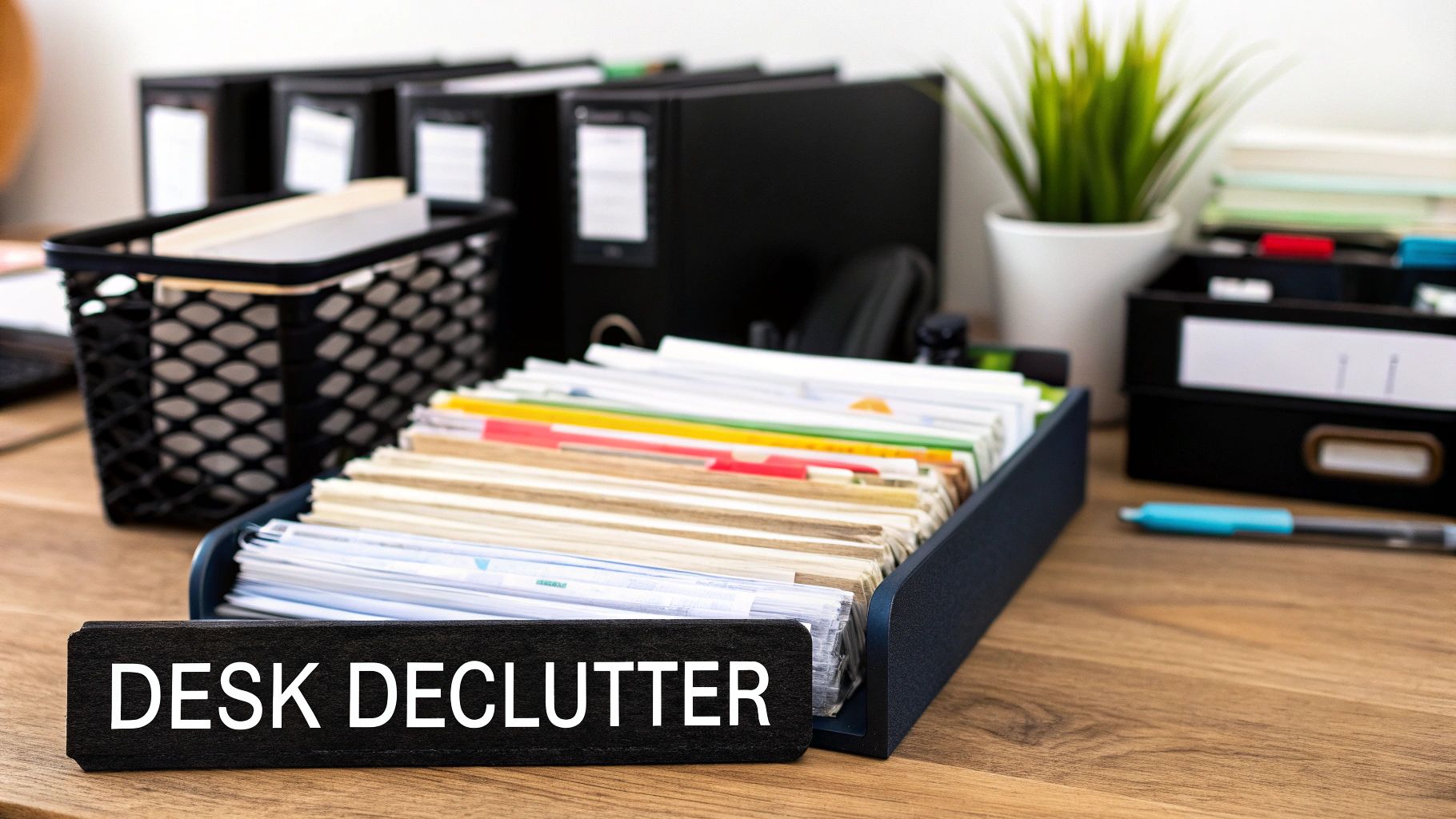
Before a single box is lifted, your most powerful tool is a well-thought-out plan. A successful office clean out lives or dies by the quality of its prep work. Diving straight into the heavy lifting without a plan is a surefire way to create chaos, blow your budget, and disrupt your entire operation.
First, define your "why." Are you clearing out for a relocation, making room for a renovation, or decluttering to boost productivity? Each goal requires a different approach. A renovation cleanout might involve temporary storage, whereas a decluttering project focuses on sorting, reorganizing, and disposal.
Defining Goals and Creating Your Inventory
Once your purpose is clear, create a detailed inventory of everything in the space. This isn't a quick glance; it requires a room-by-room documentation of all assets.
A proper inventory should be sorted into logical categories:
- Furniture: Desks, chairs, filing cabinets, conference tables, and reception area pieces.
- Electronics: Computers, monitors, printers, servers, and phones. Note any device holding sensitive company or client data.
- Documents: Both active files and archived records. This helps determine what requires secure, certified shredding.
- Supplies & Decor: Miscellaneous items like stationery, kitchen supplies, plants, and wall art.
This list does more than show the project's volume; it enables smart, informed decisions during sorting and is essential for getting accurate quotes from removal services.
Pro Tip: Use a simple spreadsheet with columns for Item, Location, Condition, and Action (Keep, Donate, Recycle, Dispose). This document will become the command center for your entire office clean out.
Assembling Your Team and Timeline
With a detailed inventory, you can create a realistic timeline. Account for lead times for booking junk removal, e-waste recycling, and charity pickups. A small office might take a week, while a large corporate headquarters could take a month or more.
Assign specific roles to your team. For example, the IT manager should oversee decommissioning electronics and ensuring data destruction. The office manager can handle logistics, like coordinating with building management for service elevators and permits.
When everyone knows their role, accountability is clear, and the office clean out runs smoothly. This is especially relevant as 73% of companies plan for employees to be in the office at least three days a week, increasing the need for clean, organized workspaces. This trend fuels optimism in the cleaning industry, where 90% of companies expect growth. You can discover more insights about cleaning industry statistics to see how these trends connect to the modern workplace.
A Practical Method for Sorting and Decluttering
Once your game plan is set, it's time to take action. The key to this phase of the office clean out is a methodical, room-by-room approach to avoid getting bogged down. Quick, confident decisions are essential.
A simple yet effective four-category framework—Keep, Donate, Recycle, and Dispose—makes sorting intuitive. Defining these categories clearly from the start eliminates confusion and maintains momentum.
This visual guide breaks the process down into three straightforward stages.
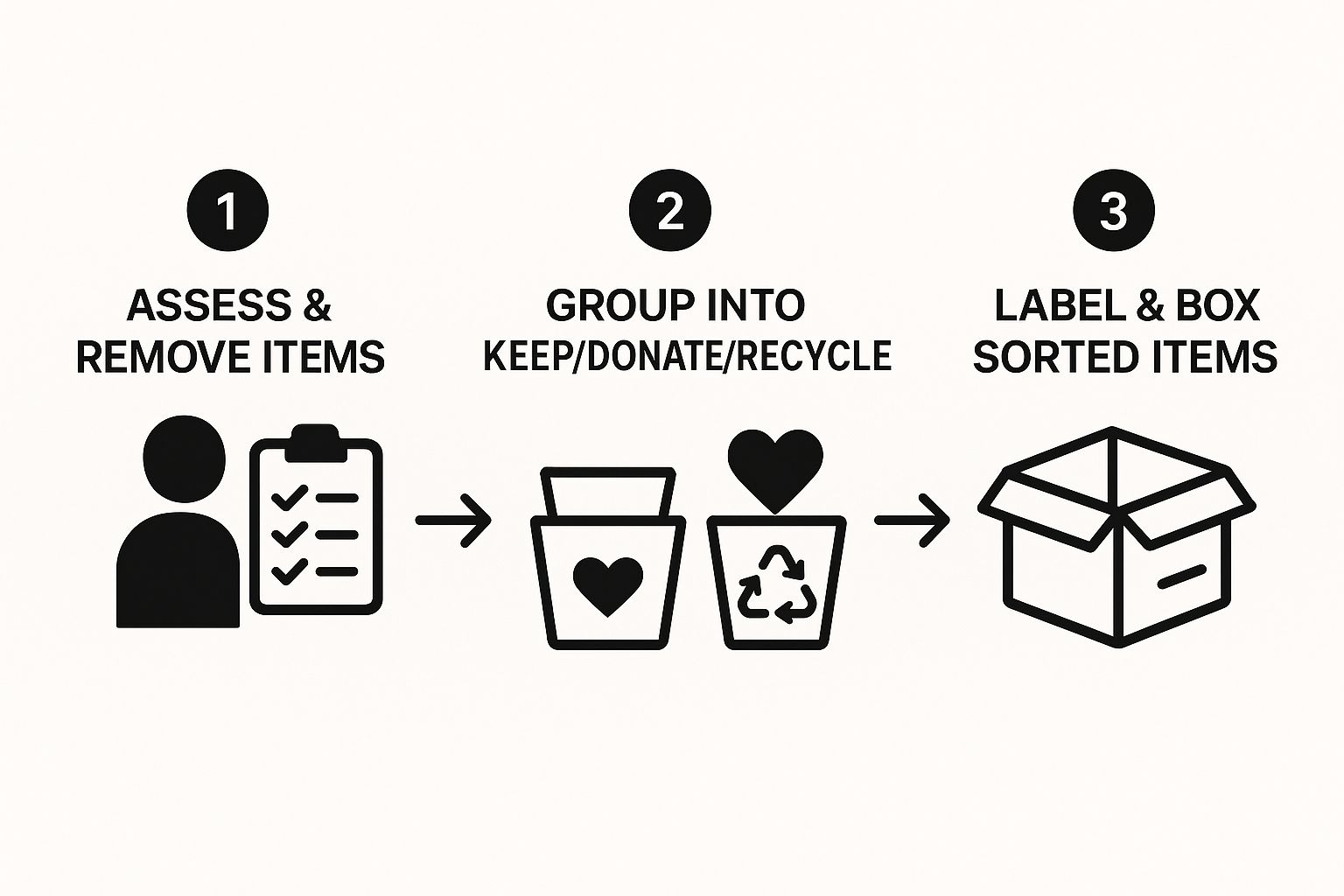
As the infographic shows, a successful sort involves assessing each item, grouping it into a category, and methodically labeling everything for removal.
Defining Your Sorting Categories
The success of your entire cleanout hinges on clearly defined categories. Your team needs to understand the criteria for each choice.
Here’s a practical breakdown:
- Keep: Assets moving to a new office or into storage. This includes essential furniture, high-value electronics, and critical files. The key question: Does this item directly support our future business operations?
- Donate: Items in good, usable condition that no longer serve your needs, such as extra office chairs, desks, or bulk supplies. Local charities often accept these.
- Recycle: Materials that can be reprocessed, primarily paper documents (after shredding) and electronic waste (e-waste). Data security is non-negotiable for electronics.
- Dispose: The last resort for anything broken, unusable, or non-recyclable. This includes worn-out furniture and general trash.
The distinction between an office clean out and an estate clean out is important. An estate project is often emotional and guided by legal rules for distributing personal belongings according to a will. An office clean out is a purely commercial job focused on business-driven asset management and operational efficiency.
To clarify further, here's a guide for handling common office items.
Disposal Options for Common Office Items
| Item Type | Best Disposal Method | Key Consideration |
|---|---|---|
| Office Furniture (Desks, Chairs) | Donate or Sell | Many charities accept furniture in good condition. You can also sell it to second-hand dealers. |
| Computers & Laptops | E-Waste Recycling | CRITICAL: Ensure the recycler provides certified data destruction to protect sensitive information. |
| Paper Documents | Secure Shredding & Recycling | Partner with a certified shredding service, especially for confidential client or employee files. |
| Office Supplies (Pens, Binders) | Donate | Schools, daycares, and non-profits are often in need of surplus office supplies. |
| Printers & Copiers | E-Waste Recycling or Take-Back Program | Check if the manufacturer has a take-back program. Otherwise, use a certified e-waste recycler. |
| Broken/Worn Items | Dispose | If an item is truly beyond repair or donation, this is the only option. Check local rules. |
This table helps your team make quick, smart decisions, keeping the project on track.
Real-World Sorting Scenarios
Applying this four-category framework varies by business type.
A law firm's office clean out will focus heavily on the Recycle category, specifically the secure shredding of vast amounts of sensitive client files. This requires a certified document destruction service that provides a clear chain of custody for compliance.
A tech startup's cleanout, however, will center on e-waste. Old servers, laptops, and prototypes require an e-waste partner that guarantees secure data erasure and environmentally sound disposal of all components. Their biggest risk is digital, not paper.
Both businesses use the same system, but they tailor it to their specific operational needs and risks.
Figuring Out Disposal and Donation Logistics
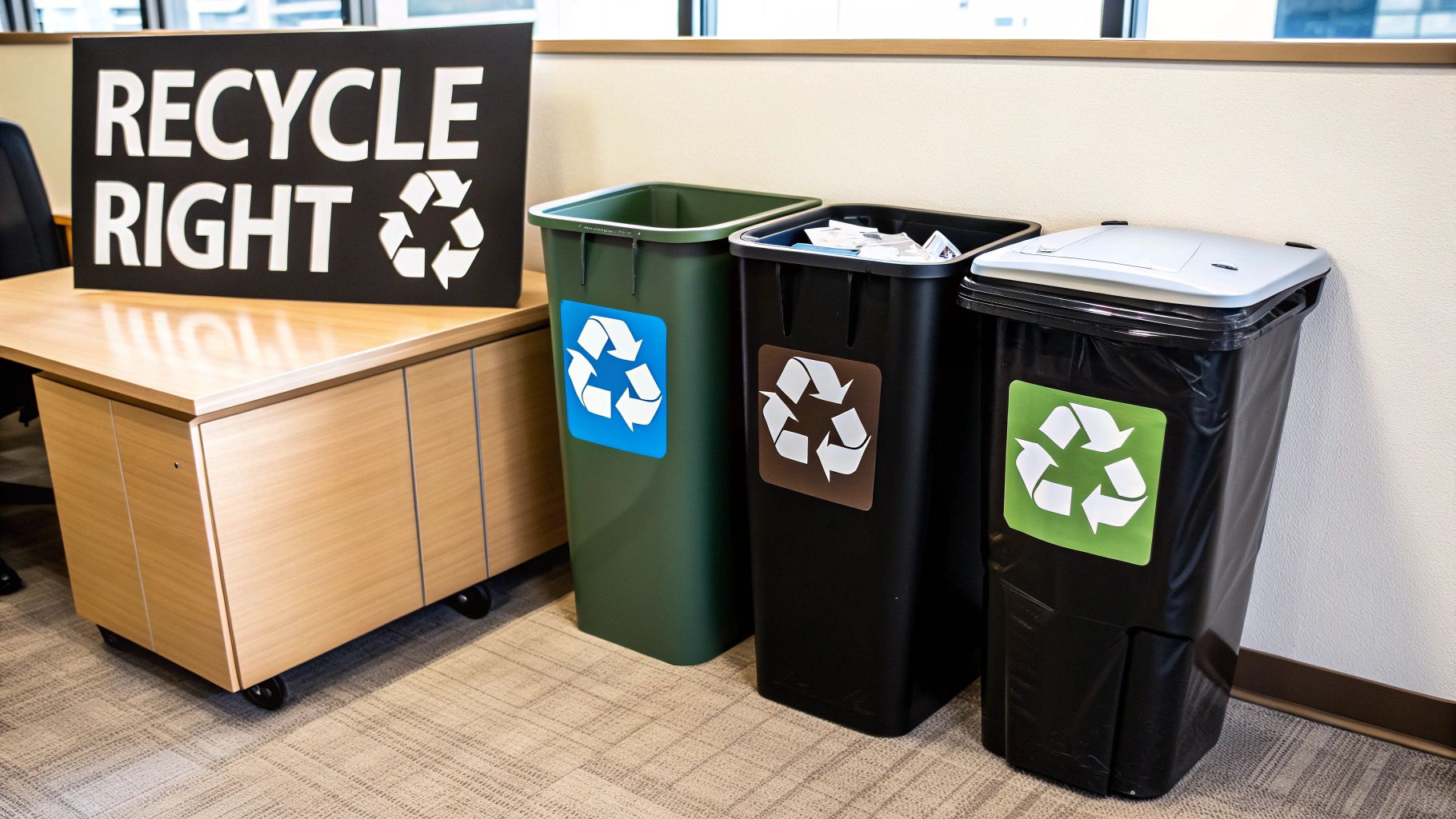
With everything sorted, it’s time for the heavy lifting. This part of your office clean out is where you execute the plan and get everything out of the building responsibly.
Your main options are hiring a professional junk removal service or renting a dumpster for a DIY approach. A professional crew provides the muscle for all lifting, loading, and hauling, saving your team from injury and speeding up the process. A dumpster rental may seem cheaper, but you provide all the labor, which can be unrealistic for large projects with bulky items.
Finding the Right Partners for Responsible Disposal
You can't just send everything to a landfill. Vet and partner with certified specialists for specific materials.
- Certified E-Waste Recyclers: Find a recycler who provides a certificate of destruction for all hard drives and data-storing devices. This document is your proof of compliance with data privacy laws.
- Charity Pickups: For usable furniture and supplies, many charities offer free pickup. Schedule these well in advance, as their calendars fill quickly. Get a detailed receipt for all donated items for potential tax benefits.
For your best items, consider high-end used office furniture markets. Selling can recover some of your investment and give quality pieces a second life.
An important distinction: An office clean out is a commercial project focused on business assets and efficiency. An estate clean out is fundamentally different, requiring navigation of sentimental attachments and complex legal directives from a will. The decision-making is far more personal and demands a higher level of sensitivity and care.
Why Professionalism Is No Longer Optional
The days of simply tossing everything are gone. The complexity of a modern office clean out—from data security to environmental regulations—is why the professional removal industry is booming.
The global office cleaning service market is projected to reach approximately $37.88 billion by 2025. This reflects a growing demand for comprehensive, professional solutions in commercial spaces, not just basic cleaning.
Choosing the right partners for your office clean out is about protecting your business, supporting your community, and upholding your environmental commitments.
Final Cleaning and Project Closeout
You’ve completed the heavy lifting. The last box is gone, and you’re left with an empty space. Now comes the final, crucial phase of your office clean out: returning the space to a pristine condition for its next occupant.
This isn’t just about making a good impression; it’s about meeting lease obligations and ensuring the full return of your security deposit.
The Deep Cleaning Checklist
Forget a quick vacuuming. Most commercial leases require the space to be returned in "broom-swept" or "move-in ready" condition. Landlords will inspect every corner.
Your goal is a top-to-bottom deep clean. Use a detailed checklist to ensure nothing is missed:
- Floors: Professional carpet cleaning to remove stains and thorough mopping of hard surfaces.
- Walls and Windows: Wipe down all walls to remove scuffs and marks. Patch any nail holes. Clean window sills and wash both interior and exterior windows.
- Fixtures and Surfaces: Dust all light fixtures, ceiling fan blades, and air vents. Sanitize countertops and cabinets in kitchenettes and breakrooms, inside and out.
- Restrooms: A complete scrub-down of toilets, sinks, mirrors, and floors until they are spotless and sanitized.
This level of deep cleaning is what distinguishes a finished project from a professionally finished one.
The final stage of an office clean out is similar to that of an estate clean out. While the latter involves preparing a personal property for sale and carries a different emotional context, both require a thorough cleaning to ensure a spotless handover. The end goal of a pristine, ready-to-occupy space is identical.
The Final Project Closeout
Once the space is sparkling, complete the final administrative tasks to close out your tenancy.
First, schedule a final walkthrough with your landlord or property manager. Bring your checklist to confirm that everything meets your lease requirements and address any issues on the spot.
Next, hand over all keys, key fobs, and access cards. This simple step officially transfers possession of the property back to the owner.
Finally, close out or transfer all utility contracts tied to the address, including internet, electricity, water, and security, to avoid unexpected bills.
If a deep clean of this scale is beyond your team's capacity, consider specialized move-out cleaning services. Professional help can save time and stress, ensuring a result that satisfies even the most meticulous landlord and guarantees a smooth end to your tenancy.
Common Questions About Office Clean Outs
Even with a solid plan, a large-scale project like an office clean out will generate questions. Having answers ready can help you navigate common challenges and keep the project on track.
Here are some frequently asked questions from businesses undertaking this process.
How Long Does an Office Clean Out Take?
The timeline depends almost entirely on the office size and the volume of items. A small, single-floor office might be completed in 2-4 days, from packing to final cleaning.
A medium-sized business may require a full week or more. A large corporate headquarters cleanout could take several weeks. The scope is key; a simple declutter is very different from a full move-out. Always factor in your team's availability and lead times for booking professional services.
What Is the Most Cost-Effective Approach?
A balanced approach is smartest. Use your internal team for initial sorting and packing of departmental items to save on labor costs.
For heavy lifting and disposal, compare professional junk removal services with dumpster rentals. While a dumpster may seem cheaper, a full-service junk removal company provides the labor, saving your team from strenuous work and allowing them to focus on their primary roles.
Donating furniture is another excellent cost-saving measure. Many non-profits offer free pickup, and you may receive a tax deduction.
The single biggest way to save money on an office clean out is through meticulous planning. Rushed projects almost always lead to expensive mistakes and last-minute fees.
How Should We Handle Sensitive Data?
This is a non-negotiable step. For paper records with sensitive information, you must use a professional shredding service that provides a certificate of destruction. This is your legal proof of compliance with privacy laws like HIPAA or GDPR.
For digital data, simply hitting "delete" is not enough. You must work with a certified e-waste recycler that specializes in secure data destruction. They use professional methods like degaussing or physical shredding to ensure data is irretrievably destroyed.
What Is the Difference Between Office and Estate Clean Outs?
While both involve clearing a property, their purpose and process are fundamentally different. The primary distinction lies in the nature of the items and the emotional context.
-
An office clean out is a commercial, business-driven project. The goals are asset management, operational efficiency, and preparing a space for its next commercial use. Decisions are based on business needs and financial value.
-
An estate clean out is a highly personal and often sensitive process, typically following a major life event like the death of a family member. It involves sorting through a lifetime of personal belongings, where decisions are guided by sentimental value, family wishes, and legal documents like a will. This type of clean out demands empathy, care, and emotional intelligence.
When you're ready to tackle your office or commercial space clear-out, you need a partner who understands the logistics from start to finish. Green Guys Junk Removal offers fast, reliable, and eco-friendly services for businesses across the Atlanta area. From furniture and e-waste removal to complete property cleanouts, our professional team handles it all. Get your upfront, hassle-free estimate today!
Article created using Outrank